REMID
Religionswissenschaftlicher Medien- und Informationsdienst e. V.

RelSciCom 2026
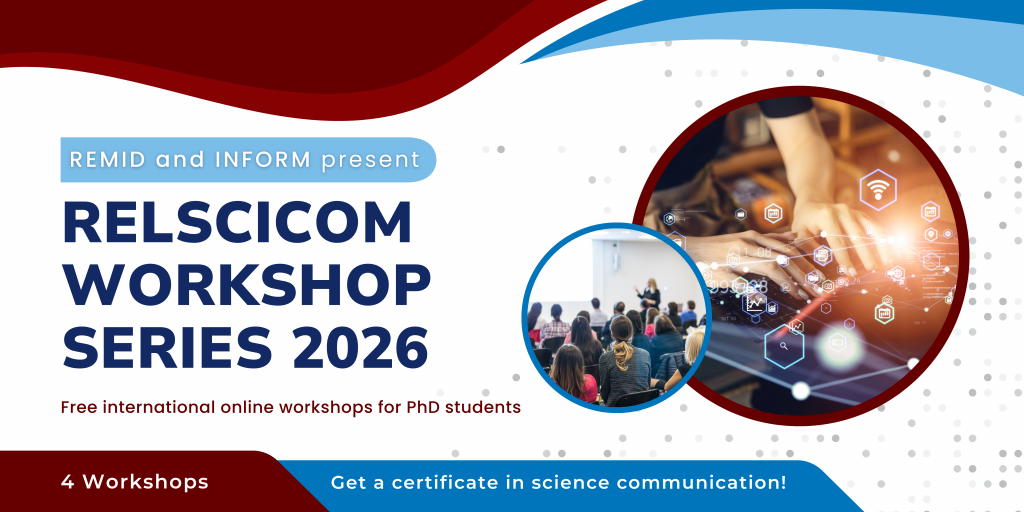
Due to last-minute cancellations, there are now a few places available for the upcoming workshops in March and April. These places will be allocated on a first come, first served basis. Please use our registration form to sign up. We will contact you shortly to confirm your place.
International Online Workshops for PhD and Postgraduate Students – organised by REMID e.V. and INFORM
What is the point of your PhD? What is the point of being an expert? How can you demonstrate your knowledge to potential employers both inside and outside academia? This series of workshops will help you to articulate the importance of well-researched social scientific information and directly contribute to knowledge creation, including through social media and databases.
Academia carries civic responsibility to contribute critical perspectives on religion and worldviews to the public sphere. It is not easy to communicate evidence-based research findings to the public, but it is more important than ever in contemporary times, where knowledge is fiercely contested and false information and ‘fake news’ leads to a crisis of expertise. These workshops will give you the confidence and the skills to enter these public debates.
When and what?
RelSciCom 2026 is a cooperation between INFORM and REMID e.V. It is a series of four workshop days during which participants will learn how, why, and through which media they can communicate their research to the general public. Each workshop will include a panel discussion with experienced researchers, a session to learn techniques and methods of transforming academic research to public knowledge, and a session to put the newly acquired methods to practice.
Participants can sign up for one workshop, or for all four, in which case they will receive a certificate of participation. Participants must be PhD students registered at either a British or German University. Workshop dates are 16th January; 13th February; 13th March; 17th April 2026.
Dates
- Friday, January 16, 2026 —
Why Go Public? - Friday, February 13, 2026 —
Self-Marketing and Social Media - Friday, March 13, 2026 —
Knowledge Exchange and Your Expertise - Friday, April 17, 2026 —
Jobs, Social Transformations and Impact
You can either attend all four workshops and receive a certificate, or you can attend only certain sessions. If there are more places than applicants, those who wish to receive a certificate will be given preference.

Workshop contents
The first in the series of workshops will serve as an introduction to the series, to the organising parties, and to the importance of going public with research.
Both Inform and REMID e.v. have a knowledge exchange and science communication mission at their core. Inform was founded on the basis of making academic research about religious movements publicly accessible in order to reduce harm caused by misinformation. This remit remains as important as ever in contemporary society in which misinformation abounds and contributes to polarisation. REMID is the central point of contact in Germany for transparent and well-founded scientific communication on religion-related topics from a value-neutral perspective.
However, fulfilling this remit takes the courage of scholars to step beyond the confines of the ‘ivory tower’ and engage in public discussions and the dissemination of their research beyond academia. Whilst this is an important part of a scholar’s ‘impact’, the practicalities of how to do it might not always be well covered in students’ degree programmes.
This workshop will provide discussions and training from scholars with lived experience of sharing their research with the public. The Workshop explores, based on our research project “female scientists into the media” why scientists should engage publicly with the media and how media visibility is structurally produced and limited. The session addresses specific features of the German media landscape and its cultural logics, offering guidance for researchers on navigating and engaging with media. It includes practical training in short media formats, such as the #ichbinWissenschaftlerin campaign.
On the second workshop day, you will learn how to self-market your research through social media. During the keynote podium discussion, our Experts will discuss various media platforms including websites, YouTube and Instagram.
Workshop: Religious Studies Goes Social Media
This workshop introduces scholars of Religious Studies to the basics of science communication on social media. It offers a practical framework for sharing research-based knowledge with public audiences in digital spaces. Using Instagram as a main example, the workshop explains how platforms work, such as visibility, formats, and engagement, and shows how scholarly insights can be adapted to social media without losing analytical depth, critical perspective, or academic standards.
Participants will learn how to adapt their own research topics into accessible and engaging social media content in order to enrich public discourse on religious topics online. In addition, the workshop offers practical guidance on communicating religious topics that receive significant media attention and public debate. To illustrate these challenges, I will draw on my own case studies, including Evangelicalism and the Church of Scientology.
Public Publishing and Interacting with Journalists
Publishing in select databases and project websites is an important way early career scholars can network with more senior scholars, establish a publication record and contribute to more accurate public understanding. Topics covered will include possibilities for direct remuneration and ways of leveraging the ideas and networks engaged in these activities for framing future grant applications and establishing ongoing partnerships for public engagement and impact.
Additionally, we will look at the Database of Religious History and the New Religiosity Project, but we will also explore other platforms such as the World Religions and Spirituality Project. This day will be led by the team behind the New Religiosity Project.
The afternoon workshop will be lead by Ruth Peacock of the Religion Media Centre (https://religionmediacentre.org.uk/) — who will discuss how to get directly involved in knowledge creation in the academic study of religions with attention to strategic uses of time. This workshop offers an introduction to practical communication skills, with tips and advice on how to share your work beyond academic circles. It begins with identifying the story itself: what is most interesting, distinctive, and relevant about your research for a wider audience. The session will then introduce core communication techniques, from choosing the right platform for your story to adapting and shaping your message for different audiences. In a world where everyone is a communicator, this introductory workshop sets out key ideas upon which further skills can be developed — writing clearly, using film and podcasts, and explaining your ideas in ways that engage and inform.
This workshop addresses the urgent need for effective science communication in the study of religions. In times of rising conspiracy theories, new right narratives, and algorithm-driven echo chambers, well-informed outreach is essential. This fosters democratic resilience, strengthens public trust in academic expertise, and highlights the societal relevance of the study of religions. It also sets students up for jobs in academia or in fields adjacent to academia, including civil service, public relations, media, museums and galleries, and research in other contexts.
By strengthening communication competencies, participants gain a competitive edge on the job market and for their postdoc projects and learn to engage diverse publics with nuanced, research-based insights. This last workshop day will discuss how Religious Studies students can have a public impact with their research, contributing to social transformation. The practical session will be split into the German and UK contexts, where students will hear from experts in both academia and beyond on careers after the study of religion.
Workshop by Danijel Benjamin Cubelic:
From Religious Studies to Anti-Discrimination and Diversity Work: Skills, Strategies and Municipal Practice
This workshop explores professional pathways for scholars of Religious Studies beyond academia, with a particular focus on public administration and municipal equality work. It addresses:
- how skills developed in Religious Studies such as contextual analysis, critical engagement with religion in public space, and the interpretation of social conflict in superdiverse societies, can be applied in anti-discrimination and diversity work,
- the role of religious literacy in addressing discrimination at the local level, the development and implementation of municipal strategies, recommendations, and action plans aimed at safeguarding equal treatment and non-discrimination in everyday administrative practice,
- institutional settings and routine challenges within local administrations, including equality offices and anti-discrimination units,
- insights from municipal practice and European exchange within the European Coalition of Cities against Racism (ECCAR), a network of more than 180 cities working on structural approaches to combating racism and discrimination.
European Coalition of Cities against Racism (ECCAR): https://www.eccar.info/en
Workshop by Rob Barward-Symmons:
How To Speak Beyond The Academy: Exploring Research in the Real World
- Based on experience working in research and impact in religious charities and think tanks, this workshop will identify four different forms of research and research communication which exist in these (and other) spaces. It explores:
- Four distinctive areas of research beyond the academy: internal research for insight; monitoring, evaluation, and impact; research for policy; and external for stakeholders;
- How skills and methods developed in Religious Studies doctoral research can be adapted for these different purposes;
- Key communication requirements and differences for reaching different audiences in each of these areas;
- How to avoid the pitfalls of academic habits to expand your employability
- It will also provide the opportunity for participants to try adapting their own work to one of these different audiences and discuss in groups.
The workshops are free of charge. Every workshop has a capacity of 25 people. No one is entitled to a place.
Schedule

Contact
Do you have any questions about the schedule or the programme? Send us an email!
On our Speakers
Judith Ackermann holds a PhD in Media Studies and is a Research Professor of Digital Media and Performance in Social Work at the University of Applied Sciences Potsdam. Her work focuses on the potential of digitalisation for society and culture. She is (co-)principal investigator of the research projects Female Scientists into Media (BMFTR 2022–2025), MyAppMyData (BMBFSFJ 2025–2028), and FEEL (EFRE 2025–2028).
Social Media: Instagram @Jiutha TikTok: @dieprofessorin
Homepage: http://www.judith-ackermann.de/
Anna-Sophie Barbutev is a communication scientist, journalist and science communicator. She worked as an academic research associate in the BMFTR-funded project Female Scientists into Media. Her research interests lie in journalism studies, science communication, and gender studies.
Social Media: Insta @asbarbutev
Anne-Kathrin Gerlieb is a sociologist and art studies scholar, and is pursuing her PhD in sociology as a scholarship holder of the Friedrich Naumann Foundation at the Düsseldorf Art Academy. She was a research associate on the BMFTR-funded project Female Scientists into Media. Her research focuses on digital transformation, sociology of art and culture, gender studies, and sociological theory.
Social Media: Instagram/TikTok: @enna.gia
Homepage: https://annegerlieb.de/
Anna Kira Hippert is a research associate and doctoral student at the Center for Religious Studies at the Ruhr University Bochum. She has an M.A. in Religious Studies and a B.A. in Religious Studies and Art History and completed an apprenticeship as an office clerk in 2011.
Her research focuses on material religion, religion and media, new religious movements, and social change online and offline, with a particular focus on the USA and modernity. During her master’s degree, she studied at the University of Kansas and was a visiting scholar at Missouri State University from March 2023 to February 2024. In Germany, she is actively involved in science and knowledge transfer on new religiosity, working with various organizations and social workers and conducting science communication on Instagram (@Sugarkane2003) and YouTube (@Ceres_Rub).
Since 2021, Anna has been working as an Affiliated Researcher at INFORM at King’s College London, an NGO founded by Prof. em. Eileen Barker. INFORM has pioneered science communication and provides precise, evidence-based information about new religious movements. As the first chair of REMID e.V., Anna wants to contribute the knowledge and experience she has gained at INFORM and in her own research and science communication. Her goal is to strengthen religious studies in Germany and promote value-free exchange about religion.
Theo Wildcroft, PhD is a yoga teacher-trainer, writer and scholar who is interested in the democratization of yoga post-lineage, somatic literacy, meaning-making and the counter-culture. She is an Associate Lecturer at the Open University, UK, Visiting Lecturer at the University of Chester, Fellow of the HEA, former Coordinator of the SOAS Centre of Yoga Studies, editor of the BASR Bulletin, an honorary member of the British Wheel of Yoga, member of the IAYT, a continuing professional development trainer and consultant for Yoga Alliance (E‑RYT® 500, YACEP®), and Council Member for the AYC.
She is the author of Post-lineage yoga: from guru to #metoo, co-writer of Leading Safe and Simple Yoga Nidras (coming soon), editor of Religion and the Sense of Self (also coming soon), and co-editor of The Yoga Teachers’ Survival Guide and Yoga Studies in Five Minutes.
Website: https://theowildcroft.com/
Dr Angela Puca is a university lecturer at Leeds Trinity University and holds a bachelor’s and a master’s degree in philosophy. In 2021, the University of Leeds awarded her a PhD in Religious Studies, published by Brill with the title “Italian Witchcraft and Shamanism”.
Her research focuses on magic, witchcraft, Paganism, esotericism, shamanism, and related currents.
Author of several peer-reviewed publications and co-editor ‘Pagan Religions in five Minutes’ for Equinox, she hopes to bridge the gap between academia and the communities of magic practitioners by delivering related scholarly content on her YouTube Channel and social media ‘Angela’s Symposium.’
Although her main platform is YouTube, she is also active on other social media platforms; she has over 40,000 followers on TikTok and over 10,000 on Instagram.
All of Dr Puca’s links: https://linktr.ee/angela_symposium
Stephen is an anthropologist of religion working in India, Japan and Vietnam. Between 2025–27, he is co-Lead of the John Templeton Foundation project “New Religiosity and the Digital Study of Eudaimonia”, which creates a new poll type for the Database of Religious History and integrates archival data from Inform and fieldwork data from hundreds of new religious groups in five global areas to explore the possible relationships between new religions and well-being.
Since receiving a PhD in anthropology from Syracuse University in 2018, he has published about new religions, tribal ecologies, affirmative action, black magic, esotericism, sexuality, manga and Tibetan Buddhism. He completed a Marie Curie postdoc at the University of Copenhagen (2022–24) and a JSPS postdoc at Kyoto University (2019). He is the co-Editor-in-Chief of the journal Contemporary Buddhism and an Asia editor at the Database of Religious History (DRH). Stephen has taught at Beijing Normal University, Vietnam National University, Tokyo Metropolitan University, Denki Tsushin University, University of Bremen, Pitt in the Himalayas, Syracuse University, Semester at Sea and Appalachian State University.
Suzanne is Honorary Director of Inform and a Senior Lecturer in Religious Studies at the Open University. She has worked at Inform in various capacities since 2002, responding to complex enquiries, giving media interviews on print, radio and televisions, updating the database, co-authoring commissioned reports, giving training to government departments and talks to schools. Her particular areas of expertise include movements with origins or inspirations from Asian and Indian traditions and contemporary groups which are interested in prophecy and the end of the world, as well as issues relating to health, healing and competing epistemologies.
Sarah has been a researcher at Inform since 2001 and responds to many of the enquiries that Inform receives, helps maintain the database of religious movements and manages Inform commissioned projects. She has written several profiles for the Inform-CenSAMM collaborative project. She is particularly interested in Pagan religions, new Christian movements, and millennial movements.
She has co-edited two volumes in the Routledge-Inform book series, including a volume on prophecy and another on counselling. Sarah’s PhD thesis is entitled ‘A Nicer Birth: Negotiating the Ideal and the Practical in Natural Birth’, in the School of European Culture and Languages, University of Kent. She has an undergraduate degree from the University of Manchester in Comparative Religion and Social Anthropology and a Masters degree from the London School of Economics and Political Science in Social Research Methods (Sociology).
Ruth Peacock is the editorial consultant and project lead at the Religion Media Centre project and oversees its work. After studying theology and teaching RE, she trained as a journalist on a local paper, freelanced in print and radio and then joined the BBC, working in many news departments, including the main newsgathering desk. She also worked on the BBC’s move into the new W1 building and studied organisational change.
Prof. Dr. Isabel Laack has been professor for the Study of Religion/s and Non-European History of Religions at Tübingen University (Germany) since 2021. Her expertise lies in the field of contemporary religiosity in Europe and pre-Hispanic Mesoamerican traditions with a theoretical focus on the aesthetics of religion (the body and the senses, music and sound, visuality and material text practices) as well as processes of cultural contact and personal and collective identity formations. She is also thinking a lot about the identity and future of the Study of Religion/s as a cultural studies’ discipline in a world facing severe challenges such as climate change, environmental destruction, political and social polarization and extremism.
With the re-establishment of the Institute for the Study of Religions and the launch of a new BA curriculum at Tübingen University, Isabel Laack is focused on revitalizing the discipline’s local and national presence. Her work on the executive board of the German Association for the Study of Religion/s further emphasizes the necessity of reflecting on the field’s social relevance. She views science communication as a key tool for translating academic research into meaningful societal contributions.
Dr Hutchings is a sociologist of digital religion and Religious Education. His PhD (Durham University, 2010) was an ethnographic study of five online Christian churches. His work has included studies of digital evangelism; online community; Bible apps; Christian videogames; and death and dying on social media. He also studies the teaching of Religious Education in primary and secondary schools, and works with the national organisation TRS-UK to build better links between schools and universities. His teaching focuses on religious ethics, media ethics, the study of religion, and research methods. He is the author of Creating Church Online (Routledge 2017), co-editor of Materiality and the Study of Religion (Routledge 2016) and Christianity and Digital Humanities: An Introduction (De Gruter 2021) and founding editor of the journal Religion, Media and Digital Culture (Brill).
Dr Tremlett joined the Religious Studies department at the Open University in 2010. He is interested in theory and method in Religious Studies, and, as well as ethnographic research in the Philippines, he has conducted research in Taiwan around death and secularism and in Hong Kong and London, on the Occupy movement. He conducted research online during the Covid pandemic on the formation of transnational “moral publics” in relation to campaigns by Filipino human rights organisations in the diaspora. He is currently leading two research projects both of which foreground issues of literacy in religion. One is focused on developing resources for FE colleges to teach religious literacy and the other attends to issues of disinformation and democracy.
Website: https://profiles.open.ac.uk/paul-francois-tremlett
Danijel Benjamin Cubelic is Director of the Office for Equal Opportunities of the City of Heidelberg and Vice-President of the European Coalition of Cities against Racism, a network of over 180 cities across Europe. His work focuses on developing practical recommendations, strategies, and policy frameworks to safeguard equal treatment and combat discrimination at the municipal level. He has particular expertise in addressing antisemitism, anti-Muslim racism, and diversity in religiously and migration-diverse societies. He studied Religious Studies and Islamic Studies in Heidelberg, Bochum, Aleppo, and Damascus. Alongside his policy work, he teaches Diversity and Gender Studies and serves as a Deputy Advisory Board Member of the German Federal Anti-Discrimination Agency, bridging local governance, European city networks, and applied anti-discrimination practice.
Motivation / Approach
Religious Studies provides analytical tools that are highly relevant for understanding social diversity, power relations, and conflict dynamics in post-migrant and superdiverse societies. In public administration, these competencies are needed not in the abstract, but in situations where institutions have to respond to discrimination within legal frameworks, political debates, and organisational constraints. The workshop offers a practice-oriented and critical perspective on how academic skills can be translated into concrete professional roles, focusing on institutional responsibilities, unresolved challenges, and learning processes in everyday municipal anti-discrimination work rather than on idealised career narratives.
Dr Rob Barward-Symmons is Senior Research and Impact Manager at the British and Foreign Bible Society and Co-Director of the Centre for the Study of Modern Christianity at St John’s College, Durham. Following an Undergraduate degree in Theology and Religious Studies and Masters degree in Religion and Society, both from Durham University, Rob completed his PhD in Sociology of Religion at the University of Kent, exploring faith formation in an evangelical youth group.
Following this he undertook a post-doctoral research placement exploring church responses to COVID, before starting at Bible Society. While at Bible Society he has co-authored two published reports: Mourning Elizabeth (2023) and The Quiet Revival (2025), which has garnered global attention. In 2025 he was seconded to a maternity cover position as Head of Research at the think tank Theos. His first monograph, Becoming Evangelical: Life and Liminalities in Evangelical Youth Groups will be published by Bloomsbury in June.
Who are REMID and INFORM?
REMID e.V.
Religious Studies Media and Information Service
REMID is the central point of contact in Germany for transparent and well-founded scientific communication on religion-related topics from a value-neutral perspective. We bring perspectives of the study of religions into society.
We are committed to providing reliable information about religions and creating well-founded access to professionally researched content — both online and offline.

INFORM
Information Network Focus On Religious Movements
Inform is an UK based independent educational charity providing information about minority religions and sects which is as accurate, up-to-date and as evidence-based as possible.
Inform exist to prevent harm based on misinformation about minority religions and sects by bringing the insights and methods of academic research into the public domain.